

Last updated: 7 September 2026
A newly formed Irish LTD often arrives as an email containing a certificate, constitution and several supporting documents. The practical question is not only what documents do you receive when an Irish company is formed, but also which counterparty will later ask for each one, and whether the document proves incorporation, ownership, governance or tax registration.
This guide covers the documents the founder receives or should ensure the company creates after formation. It doesn't cover identification, proof of address, KYC or AML material supplied to incorporate. The separate guide to documents supplied when opening an Irish company deals with what the founder hands in, rather than what comes back.
What documents do you actually receive when an Irish company is formed?
The formation pack normally divides into three groups: documents issued by the Companies Registration Office, papers produced by the company or its formation agent, and confirmations obtained after incorporation from the Registrar of Beneficial Ownership and Revenue. Each document has a practical audience. A bank may request the Certificate of Incorporation, a payment provider may ask for beneficial ownership evidence, and an investor may want the constitution, registers and first board decisions.
The CRO says an incorporation filing includes Form A1, Form G5, the constitution and, where there isn't an EEA-resident director, a bond. Form A1 records the company name, registered office, email address, directors, secretary, subscribers and share information. The CRO then issues a Certificate of Incorporation after registration, with digital certificates delivered as PDF files by email through its electronic process. The CRO's company registration guidance sets out the official filing package.
A properly organised pack should therefore identify the following:
- CRO-issued records: the Certificate of Incorporation, registered constitution, filed Form A1, CRO acknowledgement and a company search or profile printout.
- Company records: the register of members, register of directors and secretaries, share certificates or allotment evidence, first minutes or a written resolution, director and secretary consents, and the common seal where one is used.
- Post-incorporation confirmations: the RBO submission confirmation and Revenue tax registration confirmation, including corporation tax and any separately approved PAYE or VAT registrations.
Delivery is generally digital, with an emailed PDF pack and hard copies available where the founder or a counterparty needs them. The CRO's digital registration guidance confirms that a digitally certified Certificate of Incorporation can be retrieved again when official proof is needed.
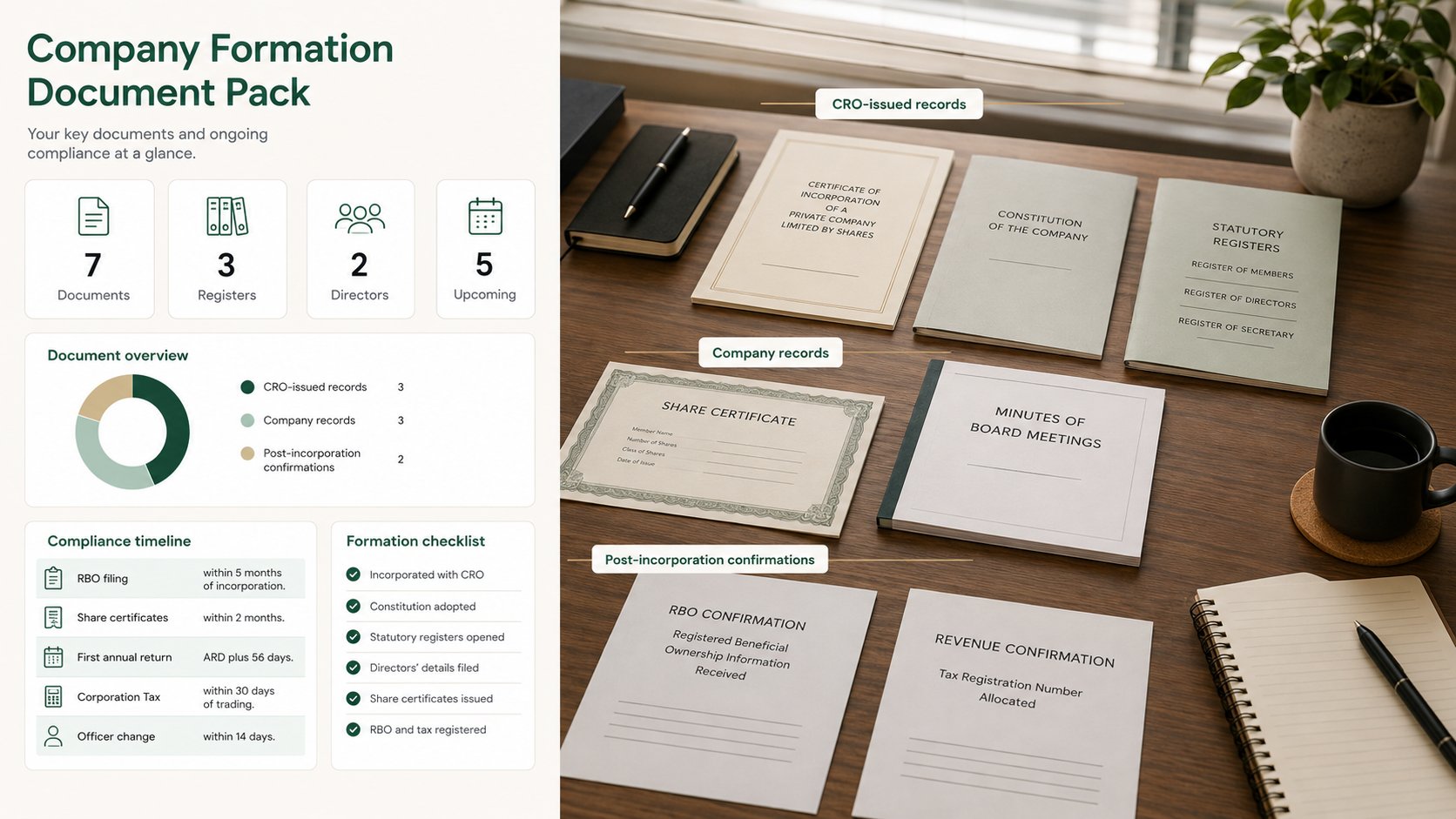
The two items most often missing from older formation files are the statutory registers and the first minutes or written resolution. They aren't merely explanatory extras. They show who owns the shares, who holds office and what decisions authorised the company to operate.
What does the Certificate of Incorporation actually prove?
The Certificate of Incorporation is the CRO's formal confirmation that the company exists as a separate legal person. Under section 25 of the Companies Act 2014, registration results in the company becoming a body corporate from the date shown on the certificate, with perpetual succession. The certificate records the company's legal identity, rather than describing how its business operates.
The face of the certificate normally shows the registered company name, CRO number, company type and incorporation date. It is digitally certified and issued as a PDF through the CRO process. The official electronic certificate should be preserved in its original form, rather than replaced with a screenshot or an unverified scan.
Practical rule: The certificate proves that the company exists. It doesn't prove that the company is tax-registered, trading, solvent or owned by a particular person.
A bank commonly requests it during account opening and KYC checks. Revenue needs the CRO number before the company's tax registration can proceed, so the certificate and CRO details form part of the evidence trail for tax onboarding. A landlord or commercial lease assignor may request it to confirm that the tenant is a corporate legal person. Payment providers, online marketplaces and investors may also ask for it during their onboarding or due diligence.
The certificate has clear limits. It doesn't identify the beneficial owners, confirm the RBO filing or establish that VAT registration has been granted. It also isn't a certificate of good standing. Those are separate questions requiring separate evidence.
Whether the pack exists as a complete set on day one, or has to be reassembled from fragments years later, is decided at formation rather than afterwards. That is the decision made at Irish resident company formation, where the officers, the registered office and the statutory records are settled before the certificate issues.
What is the Constitution and how is it different from the certificate?
The constitution is the company's internal governance instrument. It sets out the framework for shares, director powers, meetings, transfers and the relationship between the company and its members. The Companies Act 2014 requires the constitution to be delivered for registration with the incorporation application, alongside the relevant statements, consents and declarations.
The distinction is straightforward:
| Document | What it establishes | Who commonly requests it |
|---|---|---|
| Certificate of Incorporation | The company's legal existence and CRO identity | Bank, landlord, payment provider, marketplace |
| Constitution | The rules governing the company and its members | Bank, investor, solicitor, shareholder |
| Form A1 | The incorporation particulars filed with the CRO | Bank, Revenue, due diligence adviser |
The certificate is external evidence issued by the CRO. The constitution is the company's governing document, filed with the CRO and returned as part of the formation record. A bank may read it to confirm who can sign on behalf of the company. An investor may inspect share rights, transfer provisions and decision-making powers before subscribing for shares.
Most private companies limited by shares use a standard-form constitution. Bespoke provisions can be adopted where the ownership or governance arrangements require them, but the adopted document should match the company's actual structure and any later amendment must follow the statutory process, including the necessary members' resolution and filing where required.
The constitution sits with the rest of the registered paperwork, which is what incorporation and statutory documents covers as one body of records. It needs to be stored as a core corporate record, not treated as an attachment that can be discarded once the bank account opens.
The constitution also helps prevent a common practical error. A founder may send the bank the certificate and assume that legal existence answers every onboarding question. It doesn't. The bank often needs the constitution to understand signing authority and the company's governance framework.
Which CRO filings and public records form part of the formation pack?
The filed Form A1 is the starting point for the public incorporation record. It contains the company's registered details, including its name, registered office, secretary, directors, consents, subscribers and share information. Once accepted, those particulars become part of the CRO record and can be checked against the documents held by the company.
The CRO also supplies the registration acknowledgement and makes company information available through its search facilities. The resulting CRO number should appear consistently on bank forms, invoices, tax correspondence and contracts. A mismatch between the legal name, number and registered office can delay onboarding even when the company itself was correctly formed.
The public filing isn't the same thing as the company's internal books. The company must maintain its own records, including the register of members and the register of directors and secretaries. Depending on the company's circumstances, its records may also include debenture information and minutes of meetings or written decisions. The beneficial ownership record is connected to the RBO filing and must be kept current.
Revenue, a bank or a KYC provider may compare the CRO record with the internal registers. An investor's solicitor may go further, checking whether the share certificates, allotment evidence and register of members tell the same story. If the records conflict, the problem is evidential and may need correction before the transaction can proceed.
A CRO printout confirms what has been filed publicly. It doesn't replace the company's own statutory books.
The company's first annual return date falls six months after incorporation, and under section 343 of the Companies Act 2014 the return must be delivered to the CRO within 56 days of that date. The 28-day figure belongs to the pre-2017 regime and no longer applies. The later B1 annual return is a separate compliance document, not part of the original incorporation certificate. A statutory CRO filing fee applies to the B1, and the current amount is published on the CRO website.
What company-produced documents do founders receive at formation?
Several important papers don't come from the CRO at all. The company, its directors or its formation agent creates them to evidence the company's first acts.
The share certificate records the shares issued to a member. Section 99 of the Companies Act 2014 requires certificates to be delivered within two months, so the certificate should be checked against the register of members and the allotment decision. A bank may request it to verify ownership, while an investor or buyer may use it to reconcile the cap table.
The first board minute or written resolution records decisions such as appointing the secretary, adopting the constitution, approving the registered office, allotting shares and authorising the bank mandate. Written decisions should be signed by the directors entitled to vote. A bank examines this document when deciding whether the proposed signatories have authority to operate the account.
Signed director and secretary consents show that the named officeholders agreed to act. A payment provider may request them as part of its corporate onboarding review. An investor's adviser may also ask for them when verifying that appointments were properly made.
The company seal is a physical item where the company chooses to use one or requires one for a particular transaction. It isn't the document proving incorporation. It should be controlled securely, with its use recorded in the company's decision records.
A registered-office confirmation letter may come from the address provider or formation agent rather than the CRO. A landlord may ask for it when checking where official notices can be served, but it isn't a substitute for the CRO's registered-office entry.
The documents that should be demanded before the file is closed are:
- Share evidence: share certificates and the corresponding allotment record.
- Authority evidence: first minutes or a written resolution approving the initial arrangements.
- Officeholder evidence: signed consents and the relevant registers.
- Corporate custody items: the common seal and registered-office confirmation, where applicable.
Which post-incorporation confirmations come from the RBO and Revenue?
The RBO and Revenue confirmations answer different questions. The RBO filing identifies the company's beneficial ownership record, while Revenue confirms the tax registrations accepted for the company. Neither replaces the Certificate of Incorporation.
A newly incorporated entity has five months from incorporation to register its beneficial ownership with the RBO, according to CRO and RBO guidance. The filing confirmation should be saved, along with any transaction reference or number issued through the RBO process. Banks and notaries may request that confirmation when checking beneficial ownership.
Revenue requires the company to have a CRO number before tax registration can begin. After the company starts trading, it must file a Statement of Particulars within 30 days of trading, using Form 11F CRO with Revenue's National Companies Unit. Corporation tax registration is separate from incorporation. PAYE and VAT registrations, where applicable, are also separate applications and shouldn't be assumed to exist merely because the company has a CRO number.
| Confirmation | Issuing body | What it proves | Typical requester |
|---|---|---|---|
| RBO submission confirmation | RBO | Beneficial ownership filing was submitted or accepted | Bank, notary, KYC provider |
| Corporation tax registration | Revenue | The company is registered for the relevant tax | Accountant, Revenue, bank |
| PAYE registration | Revenue | Employer registration where accepted | Payroll provider, accountant |
| VAT registration | Revenue | VAT registration where separately approved | Customer, marketplace, accountant |
The Revenue guidance for a new company registering for tax is the correct reference for the tax sequence. If an expected confirmation is missing, the practical response is to check whether the application was submitted, recover the reference through the relevant portal or contact the responsible authority. A prepared but unsubmitted RBO filing has no evidential value.
Who asks for which document after the company exists?
The formation pack works best as a counterparty map. A founder shouldn't send every file to every requester. The right document depends on what the counterparty is trying to verify.
| Document | Typical requester |
|---|---|
| Certificate of Incorporation | Bank, payment provider, landlord, marketplace |
| Constitution | Bank, investor, solicitor, shareholder |
| Filed Form A1 | Revenue, bank, accountant, due diligence adviser |
| CRO company profile | Bank, landlord, marketplace, investor |
| Register of members | Investor, buyer, lender, solicitor |
| Register of directors and secretaries | Bank, accountant, investor counsel |
| Share certificates | Bank, investor, buyer, lender |
| First minutes or written resolution | Bank, investor counsel, auditor |
| RBO confirmation | Bank, notary, KYC provider |
| Revenue tax confirmation | Accountant, bank, customer, marketplace |
A bank normally starts with the certificate, constitution, CRO profile and beneficial ownership evidence. A payment provider may ask for the same core documents, then request director consents or a description of the business. A landlord is more likely to focus on legal existence, the registered office and the identity of the contracting company.
Revenue uses the CRO identity as the foundation for tax registration, but the tax confirmation is the document that demonstrates the separate Revenue relationship. An investor, lender or buyer generally needs deeper evidence, including the share register, certificates and minutes showing how ownership and authority were established.
Counterparty test: Before sending a document, identify whether the requester needs proof of existence, authority, ownership, address, tax registration or beneficial ownership.
That approach avoids two opposite mistakes. Sending the entire formation file can expose unnecessary personal information, while sending only the certificate may leave a bank or investor unable to verify authority and control.
Which items can be replaced if lost, and which cannot?
The recovery route depends on who created the document. CRO records are generally recoverable through official searches or certified-copy requests. Company records require reconstruction from the company's own evidence and shouldn't be treated as interchangeable with a CRO printout.
The Certificate of Incorporation, filed Form A1, constitution and CRO company profile can be obtained again from the CRO, including certified copies where an official version is required. The CRO also notes that duplicate certificates can be retrieved, which matters when a bank, tax authority or counterparty rejects an informal scan.
The RBO presenter can generally retrieve filing evidence through the RBO portal. If beneficial ownership information changes, the updated record must be filed within 14 days under Regulation 23(5) of S.I. No. 110/2019. The original RBO confirmation should still be retained because it shows the filing history at the relevant time.
Company-produced records need more care:
- Registers: Reconstruct the register of members and other statutory registers from filed forms, allotments, transfers and resolutions. The company must maintain its records as required by the Companies Act 2014.
- Share certificates: Reissue them through the company under section 99, ensuring that the certificate agrees with the register and the underlying allotment.
- First minutes: Recreate the record from evidence of decisions taken. A missing minute can't be replaced by inventing a historical decision.
- Seal: Replace the physical seal if necessary, then control its use through proper company records.
Minutes are the least recoverable item because they record decisions, not merely registration data. If the original pack is missing, the company should gather the signed resolutions, bank mandate, allotment evidence and correspondence that establish what happened, then document the remediation accurately.
Registration in practice takes about 10 to 15 working days from a correctly completed submission, and none of this paperwork exists until the certificate issues. The CRO and Revenue should be consulted directly for current processing information rather than relying on any delivery estimate. The company should also record the first annual return date, preserve the incorporation pack and maintain a compliance calendar from the day the certificate is issued. Where a pack has to be built from nothing, having it produced at formation through Irish resident company formation is cheaper than reconstructing it later.
What is the difference between documents supplied and documents received?
Documents supplied are the founder's identification, address and incorporation information. Documents received are the CRO certificate, constitution, filed records, company registers, ownership evidence, minutes and later RBO or Revenue confirmations.
Does the Certificate of Incorporation prove tax registration?
No. It proves that the company was incorporated and identifies its CRO number. Revenue tax registration is a separate process, and PAYE or VAT registration requires its own confirmation where applicable.
Which documents should a bank receive first?
The bank usually starts with the Certificate of Incorporation, constitution, CRO profile and beneficial ownership evidence. It may then request the first minutes, share certificates, director consents and tax registration confirmation.
What should a founder do if the statutory registers are missing?
The company should obtain the CRO records, gather allotment and appointment evidence, and reconstruct the statutory registers accurately. The first minutes should also be rebuilt from genuine evidence, but no decision should be recorded as having occurred if it wasn't taken.
Chern & Co (RegisterCompany.ie) can organise the Irish resident company formation process and provide the core corporate documents that counterparties typically request after incorporation. Founders can review Irish resident company formation and use the resulting pack as the basis for banking, tax registration and ongoing corporate record-keeping.
This article is general guidance, not legal or tax advice.


